
-
About Us
Why Choose Us?The company possesses advanced capabilities in mold design, injection molding, and automated assembly, supported by a professional quality inspection team to ensure product reliability. A dedicated design team continuously drives product innovation, providing customers with high-quality spray solutions.
 Coming From China, Marketing To The World.
 -
Products
-
News
 English
 Français
 русский
 Español
What Is Perfume Spray? How Atomizers Work, Mist Types and Packaging Basics
Content
- 1 What Exactly Is a Perfume Spray?
- 2 How a Perfume Spray Pump Actually Works
- 3 Perfume Spray Concentrations: From Parfum to Body Mist
- 4 Fine Mist, Perfume Mist, or Roll-On: Matching Hardware to Formula
- 5 How the Format Shapes Sillage, Longevity, and Skin Feel
- 6 A Buyer's Checklist for Perfume Spray Packaging
Press the actuator on a fragrance bottle once and a metered dose of liquid, usually between 0.05 and 0.1 ml, is forced through an orifice narrower than a sewing pin, leaving as a cloud of droplets fine enough to hang in the air instead of wetting the skin. So, what is perfume spray? It is a pump-and-actuator system, commonly called an atomizer, that converts liquid fragrance into an even, breathable mist. The formula is what you smell, but the spray hardware decides how the scent leaves the bottle, how it lands on skin, and how consistent every press feels. This guide explains how the mechanism works, how sprays differ from mists and roll-ons, and what to check when sourcing pumps at scale.
What Exactly Is a Perfume Spray?
A perfume spray, also called a fragrance atomizer or perfume sprayer, is a dispensing device that breaks liquid fragrance into a fine mist on demand. In packaging terms, the hardware is built from five functional parts:
- Actuator: the button you press; its internal channel shapes droplet size and spray pattern.
- Pump body: houses the piston and a metering chamber that draws a fixed dose, typically 0.05 to 0.1 ml per stroke.
- Spring and one-way valve: recharge the chamber when you release and seal the bottle when you do not.
- Dip tube: carries liquid from the bottom of the bottle up to the pump.
- Mounting collar: crimped aluminum or threaded plastic that locks the pump onto the bottle neck.
This is why two perfumes with identical juice can feel completely different in use. The spray is delivery engineering, not just a cap with a button, and mist fineness, stroke consistency, and seal quality are where premium and cheap packaging part ways.
How a Perfume Spray Pump Actually Works
Inside every sprayer sits a miniature positive-displacement pump. Each press runs the same four-step cycle:
- Press: the actuator pushes the piston down, compressing the spring and squeezing liquid out of the metering chamber toward the nozzle.
- Atomize: as the liquid exits the micro-orifice it shears into droplets and mixes with air drawn through side channels, producing the fine mist.
- Refill: releasing the button lets the spring push the piston back, creating suction that draws a fresh dose up the dip tube.
- Repeat: the chamber is already charged, so the next press delivers the same dose again: no shaking, no pouring, no spills.
Two details separate a premium sprayer from a mediocre one. First, droplet size: droplets measured in tens of microns feel like a light cloud, while a coarse spray wets the skin. Second, dosage consistency: a well-made pump delivers the same volume stroke after stroke, which is what makes a 50 ml bottle predictable in daily use.
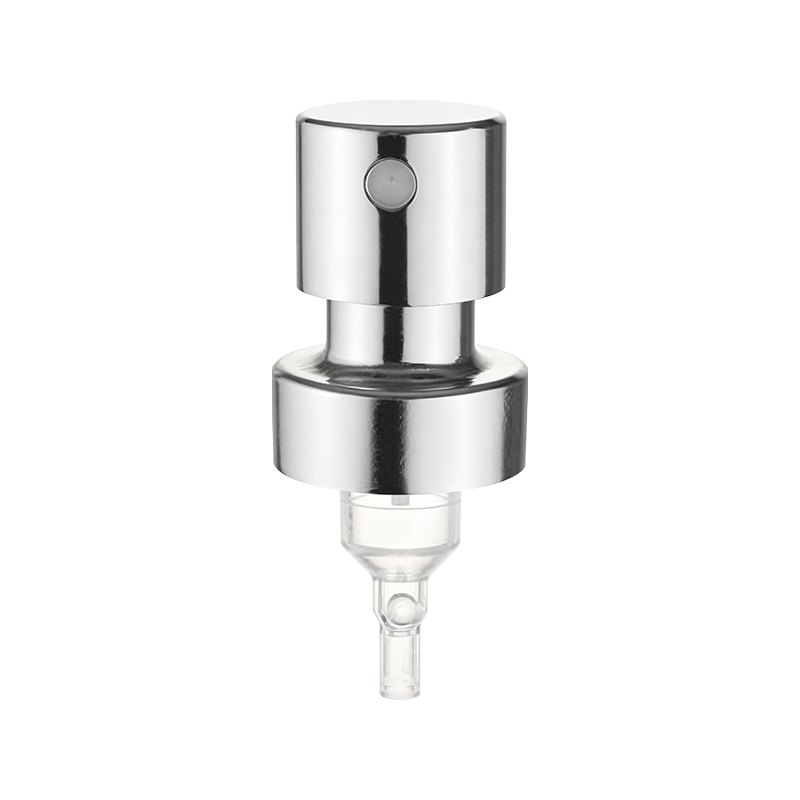
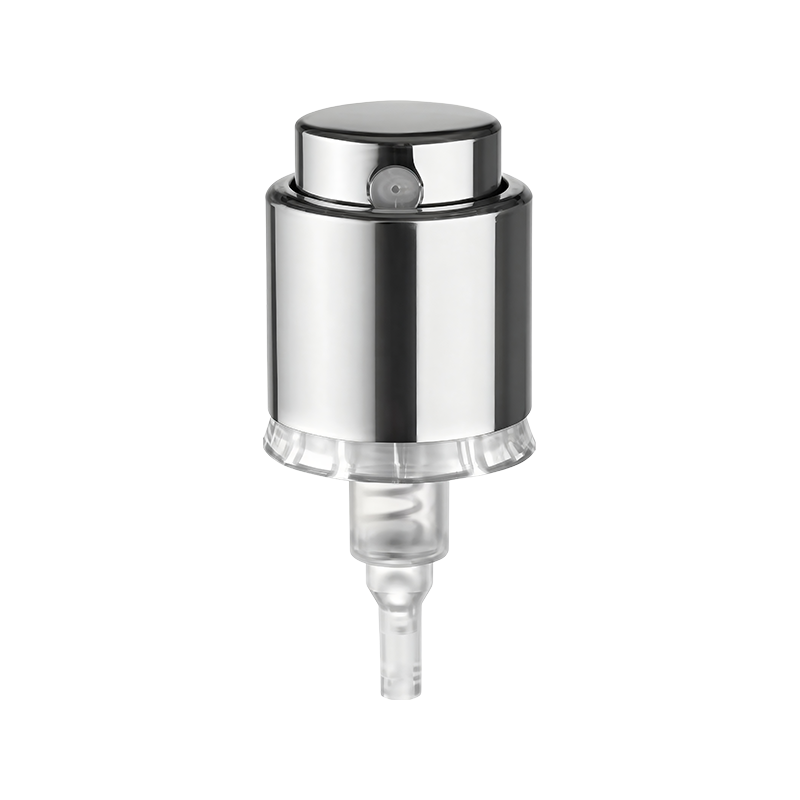
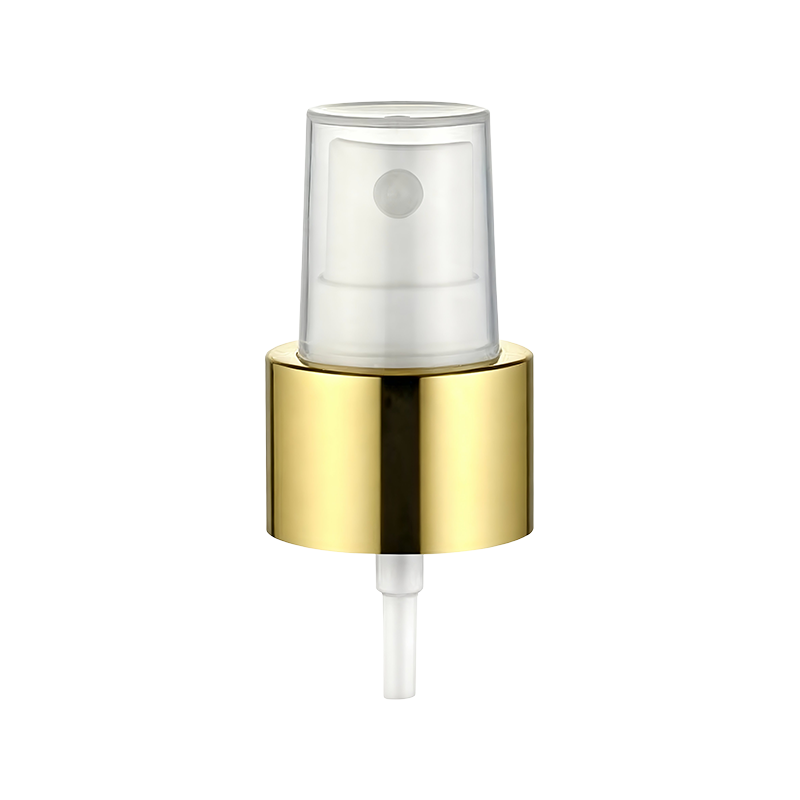
 0.06cc Aluminium Crimp-On Perfume Sprayer PumpThis crimp pump delivers a fine 0.06ml mist in 15mm, 18mm, and 20mm sizes with a permanent leak-resistant seal. It suits the article's point on consistent dosage and droplet size for premium eau de parfum filling.View Product →
Crimp-type pumps like the one above are the classic construction for eau de parfum and extrait presentations: the aluminum collar is pressed around a matching glass crimp neck, creating a permanent, leak-resistant seal that survives filling lines and international transit.
Perfume Spray Concentrations: From Parfum to Body Mist
The spray hardware stays broadly similar across formats; what changes is the formula inside. Fragrance oil concentration drives alcohol content, projection, price, and how often the user reapplies. Perfume sits at the top of the scale at roughly 15-20% fragrance oil, while body and perfume mists run at about 1-5%.
| Format | Fragrance oil | Alcohol base | Typical wear |
|---|---|---|---|
| Parfum (extrait) | 20-30% | Low | 8-12 hours |
| Eau de parfum (EDP) | 15-20% | Medium | 6-8 hours |
| Eau de toilette (EDT) | 5-15% | High | 3-5 hours |
| Eau de cologne | 2-4% | High | Up to 2 hours |
| Perfume / body mist | 1-5% | High | 1-2 hours |
| Perfume oil (roll-on) | Varies | None | Long, close to skin |
Because alcohol evaporates faster than oil, alcohol-based sprays lift the top notes into the air quickly: that is the bright burst of the first minutes and the trail other people notice. Oils evaporate slowly and stay close to the skin. Neither approach is better; they are different wearing experiences, and the packaging format normally follows the formula rather than the other way round.
Fine Mist, Perfume Mist, or Roll-On: Matching Hardware to Formula
Three hardware formats dominate the fragrance aisle, and each one suits a different product brief:
- Crimp and threaded perfume sprayers: the standard for EDP and EDT in glass bottles, tuned for an even, wide mist with tightly controlled output.
- Fine mist sprayers for lighter formats: perfume and body mists need a soft, wide cloud that can be applied generously; all-plastic recyclable versions are increasingly requested by brands with sustainability targets.
- Roll-on bottles: alcohol-free perfume oils, precise application on pulse points, and spill-resistant travel dosing.
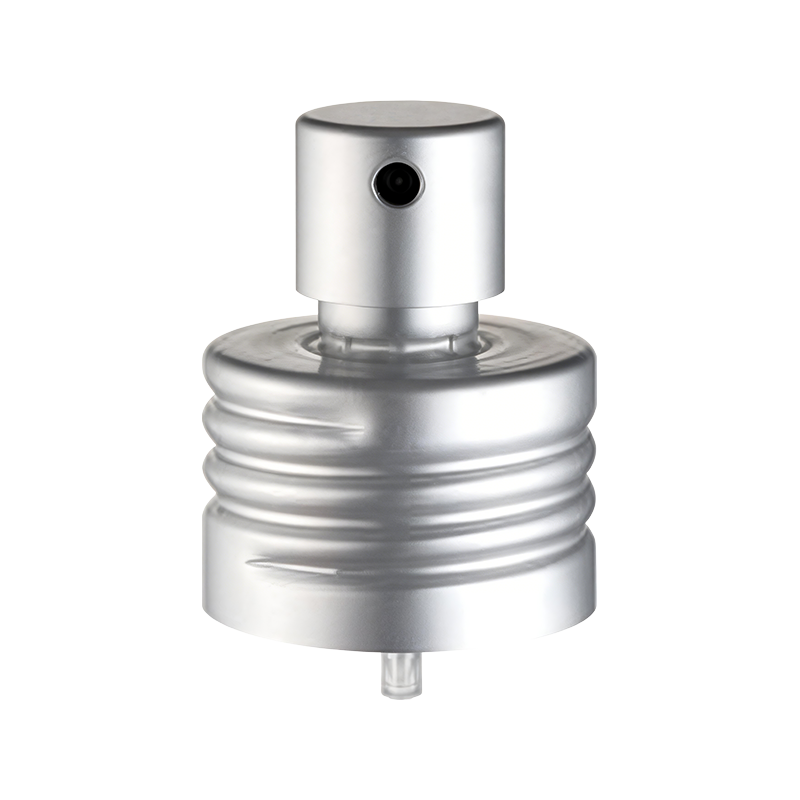
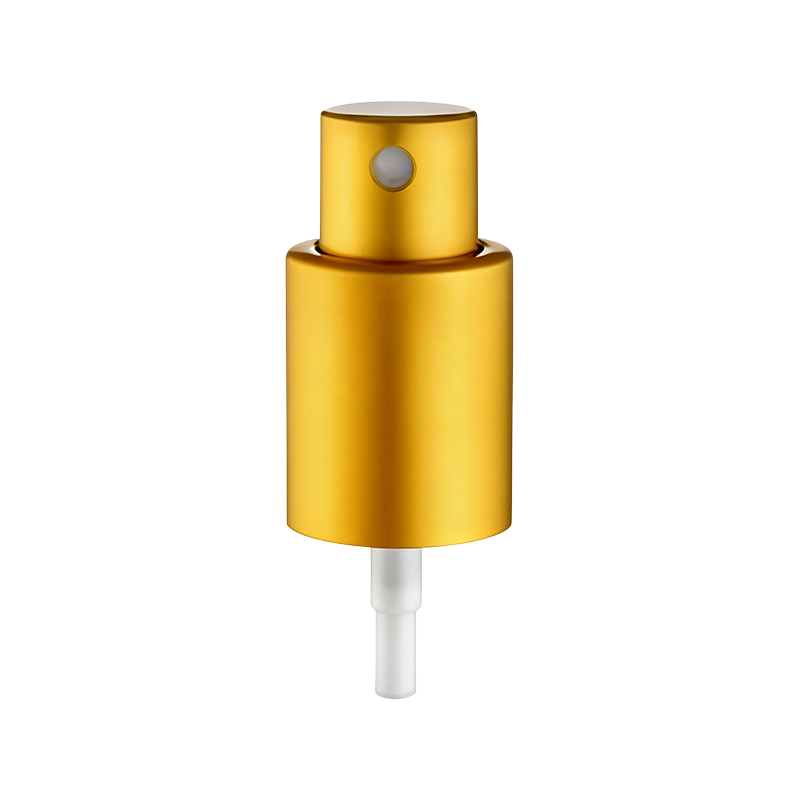 0.12cc Aluminium Perfume Mist Sprayer (18/410, 20/410)A threaded aluminium sprayer offering 0.12ml per stroke in 18/410, 18/415, and 20/410 neck finishes with customizable dip tube. It fits the article's reminder to match threaded sprayers to the correct screw neck.View Product →
Neck finish is the quiet detail that decides whether any of this works. Crimp pumps need matching FEA-standard crimp necks on glass (13, 15, 18, or 20 mm are the common sizes), threaded sprayers need the correct screw neck such as 18/410 or 24/410, and roll-ons need a compatible roller ball and collar. Get this one specification wrong and an otherwise excellent pump becomes scrap.
How the Format Shapes Sillage, Longevity, and Skin Feel
Sillage, the scent trail you leave behind, and longevity behave differently across formats. Alcohol-based sprays project boldly during the first hour because the alcohol flashes off quickly and carries the top notes with it; the scent then softens into the drydown. Perfume oils move in the opposite direction: minimal projection up front, but the fragrance sits on the skin for hours within an intimate radius.
Application habits that make any format perform
- Spray EDP on pulse points such as wrists, neck, and behind the ears, where body warmth helps diffusion.
- Do not rub sprayed perfume; friction breaks the top notes apart and shortens the opening.
- Use mists for hair, clothing, and generous all-over layering, then anchor the scent with a stronger EDP on skin.
- For sensitive skin, alcohol-free roll-on oils reduce sting and dryness.
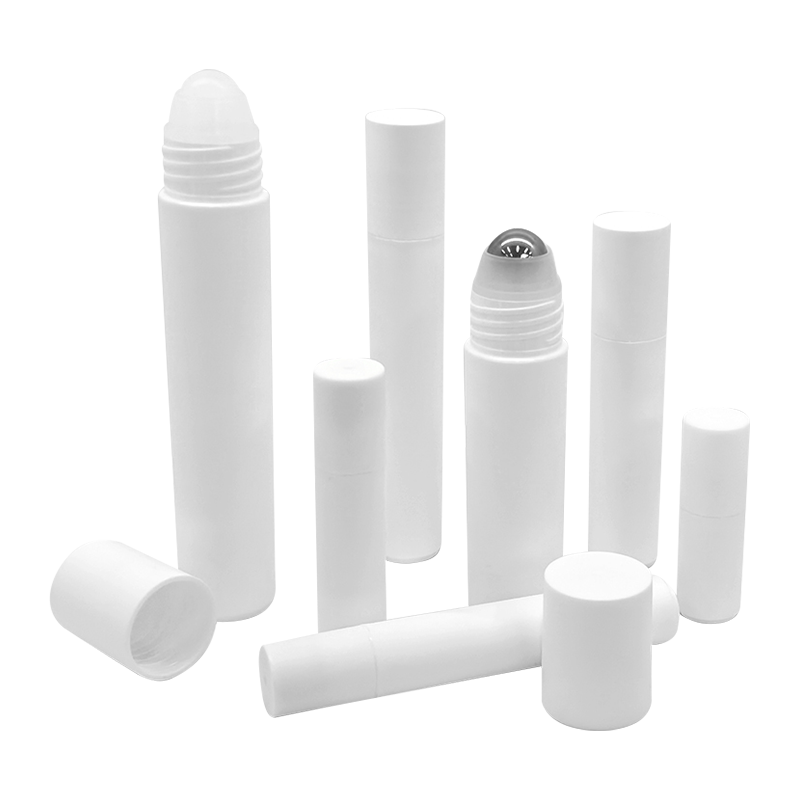 Plastic Roll-On Bottle for Perfume OilsAvailable from 3ml to 30ml, this roll-on bottle applies fragrance directly via its roller ball for controlled, low-waste use. It matches the article's discussion of perfume oils and intimate, long-lasting application.View Product →
Dosage precision pays off here as well: a metered spray gives repeatable layering from bottle to bottle, while a roll-on relies on its roller ball for controlled, low-waste application.
A Buyer's Checklist for Perfume Spray Packaging
If you are sourcing sprays for a brand, judge the component on these criteria before you look at price:
- Mist quality: request spray pattern photos or physical samples and look for a uniform cone with no streaming or spitting.
- Dosage accuracy: metered output should stay consistent across thousands of strokes, so ask for tolerance data, not just a nominal figure.
- Material compatibility: high alcohol content and natural aroma oils can stress unsuitable plastics, so verify that the pump, gasket, and dip tube resist swelling and discoloration.
- Seal integrity: crimp pumps must match the bottle's crimp neck dimensions exactly, or the pack will leak and evaporate on the shelf.
- Actuator feel and locking: a crisp press without wobble, plus a transit lock or cap for shipping.
- Recyclability: mono-material, all-plastic pump options simplify recycling claims for eco-minded lines.
Manufacturing discipline sits behind all six points, so treat supplier capability as part of the specification. A qualified partner should run ISO 9001-certified production with a high share of automated assembly; at GreenYard Tools, for example, key-process automation runs at about 90% and published batch acceptance exceeds 99.5%. For a closer look at constructions and materials, see our guide to crimp pump types and materials.
A perfume spray is a metered atomizing system, and its real quality is decided in the tooling, materials, and assembly, not in the marketing copy. Whether you are launching an eau de parfum in a crimp-sealed glass bottle or a body mist in a recyclable fine sprayer, matching pump, formula, and neck finish is what the customer feels with every press.
GreenYard Tools Co., Ltd manufactures fine mist sprayers, crimp perfume pumps, and roll-on bottles with in-house mold design, injection molding, and automated assembly, and has delivered custom packaging for more than 500 brands worldwide. Contact our team for samples, specifications, or a quotation, and expect a reply within 12 hours.
-
What Is a Fine Mist Sprayer?
A fine mist sprayer is a cosmetic packaging component designed to atomize liquid formulas into ultr...
-
What's Inside a Lotion Pump and How Does It Work ?
A lotion pump is a precision dispensing closure that draws liquid product from a bottle and delivers...
-
Airless Pump Makeup Packaging: How It Works and What Brands Should Specify
Open a foundation that has been sitting in a warehouse for eighteen months and the first thing a pa...
-
What Is a Lipstick Applicator? How the Mechanism Works
What Is a Lipstick Applicator? The Direct Answer A lipstick applicator is the internal mechanical c...
Copyright © GreenYard Tools Co.,ltd. All Rights Reserved.
Personal Care Packaging Manufacturer Custom Perfume Sprayers Factory