
-
About Us
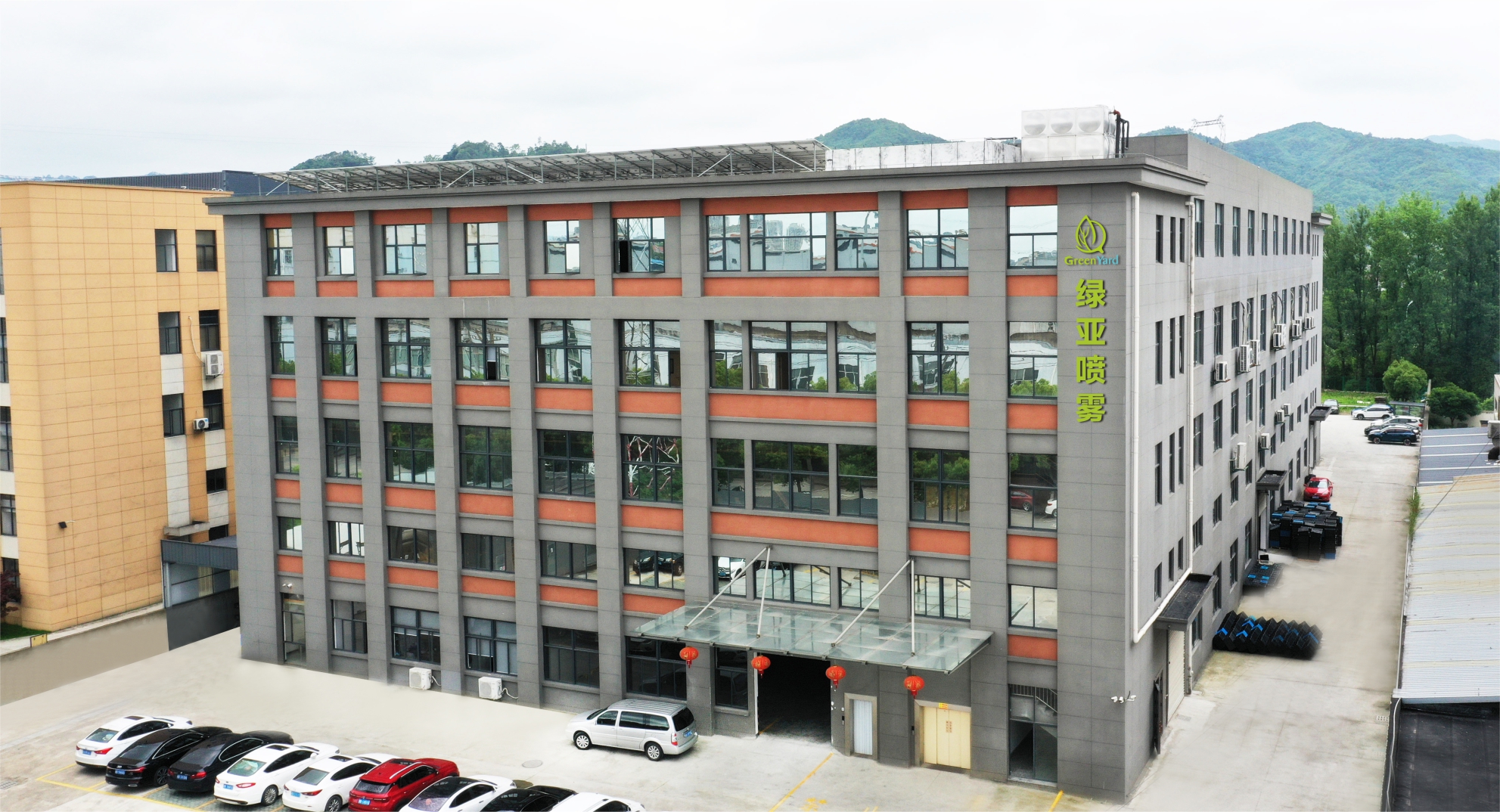
Why Choose Us?The company possesses advanced capabilities in mold design, injection molding, and automated assembly, supported by a professional quality inspection team to ensure product reliability. A dedicated design team continuously drives product innovation, providing customers with high-quality spray solutions.
 Coming From China, Marketing To The World.
-
Products
-
News
 English
 Français
 русский
 Español
Airless Pump Makeup Packaging: How It Works and What Brands Should Specify
Content
Open a foundation that has been sitting in a warehouse for eighteen months and the first thing a packaging engineer checks is not the shade. It is whether the formula has separated, dried at the nozzle or started to smell different. Airless pump makeup packaging exists to remove that variable. There is no dip tube and no head space above the liquid: the formula sits in a sealed chamber, and a piston rises from the bottom as you press the actuator, so nothing is pushed back uphill and no air replaces what leaves the bottle.
The short answer: airless packaging costs more per unit and asks more of your filling line, but it buys a longer shelf life, a cleaner dose down to the last gram, and a format that supports premium claims you can defend on pack. It is worth specifying when a formula is oxidation-sensitive, expensive per millilitre, or sold on dose precision. Cream foundations, serum-concealers, primer gels and tinted moisturisers are the usual candidates.
This article is written from the manufacturing side of the table. GreenYard Tools moulds, assembles and decorates dispensers and airless bottles for brands worldwide, so the points below come from tooling decisions, filling trials and return-claim patterns rather than from a brochure.
How an Airless Pump Dispenses Makeup, Step by Step
Chamber, piston and one-way valve
A typical airless bottle has three working parts you can actually see when it is cut open: a rigid outer body, a piston that slides against the inner wall, and an outlet valve at the top. Product sits between the piston and the valve. When the actuator is pressed, the pump creates a pressure difference, the valve opens briefly, and a fixed volume leaves the nozzle. When the actuator returns, the valve closes and the piston creeps upward by exactly the volume that was dispensed.
That last detail matters more than it sounds. Because the piston follows the product, the chamber stays full at all times. There is no air pocket, no sloshing, and no channel where the formula can oxidise between uses.
Dosage and how many doses you really get
Airless pumps for makeup are normally built around a fixed dose per stroke, commonly somewhere between 0.15 cc and 0.5 cc. A 15 ml airless bottle running a 0.23 cc dose gives roughly 65 full presses; a 30 ml bottle on the same pump gives about 130. Dosage is a design choice, not an accident, and it drives how the consumer experiences the product: a concealer that delivers 0.5 cc per press feels wasteful, while a body product on 0.15 cc feels broken.
What Airless Packaging Changes for the Formula
Airless construction reduces oxygen contact during the use phase, but it does not automatically make a product preservative-free. Two things do change measurably: oxidative degradation slows, and water loss at the surface stops. For a water-in-silicone foundation or a vitamin-rich serum, that can be the difference between a stable two-year shelf life and a formula that turns at month ten.
| Packaging format | How product leaves | Air contact during use | Residual product left | Typical fit |
|---|---|---|---|---|
| Airless pump bottle | Piston rises, product pushed through a one-way valve | Effectively none | About 3 to 5 percent | Foundations, primers, serums, SPF fluids |
| Lotion pump with dip tube | Suction pulls liquid up the tube | Air re-enters with every stroke | About 8 to 12 percent | Cleansers, body lotion, thin gels |
| Jar or pot | Scooped or poured out by hand | Fully open at every use | 5 to 10 percent on the wall | Wax balms, thick butters |
If you are still weighing the format against a standard bottle, the practical trade-offs are summarised in this overview of the benefits of an airless bottle for cosmetic brands.
Matching the Pump to the Makeup You Sell
The pump and the formula have to be chosen together, because viscosity decides whether the piston travels smoothly or judders. A few pairings that come up constantly in development:
- Liquid and cream foundation: medium-viscosity emulsion, 0.23 cc to 0.5 cc dose, wide nozzle to avoid streaking.
- Tinted moisturiser or skin tint: thinner fluid, 0.2 cc to 0.3 cc dose, tighter nozzle for control.
- Concealer and serum hybrids: 0.15 cc to 0.2 cc dose, small orifice, often a fine metal tip for spot application.
- Primer gel and silicone-based balm: needs a pump with a heavier return spring, otherwise the piston stalls and the dose drifts short.
- SPF fluid: check compatibility with UV filters and alcohol carriers, which attack some elastomer seals over time.
Get this wrong and the failure always looks the same on a customer review: the bottle stops pumping before it is empty, or it spits a thin streak instead of a metered line.
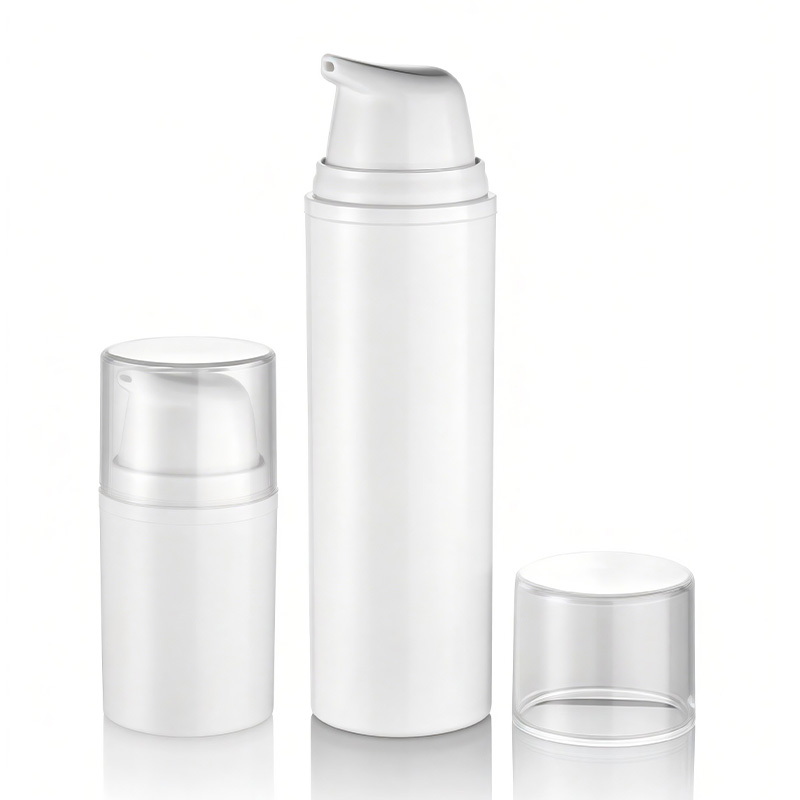 Plastic Airless Serum Pump Bottle1. Volume Available: Available in 30g, 50g, and 75g, offering flexibility to cater to different packaging requirements and consumer preferences.View Product →
Materials, Finish and Refill Design
Most airless makeup bottles are built in polypropylene because the piston needs to slide against a compatible, low-friction wall and both parts must resist the formula. Beyond the basics, three upgrades appear again and again in briefs:
An aluminium outer shell, a silk-screened body, matte soft-touch coating or hot stamping turns a functional bottle into a shelf statement. Test decoration adhesion with the alcohol or oil in your actual formula, not with water.
Refillable inner cartridges
A replaceable inner cartridge lets the consumer keep the decorated outer shell and swap only the wetted parts. It cuts packaging weight, supports a refill story on pack, and keeps the pump geometry identical between the first purchase and the refill. It also means your filling line needs a defined cartridge handling and sealing step, so involve the supplier before your mould opens.
Recycled and mono-material options
All-plastic airless builds are easier to sort than mixed metal-and-plastic assemblies. If recyclability is a claim on your pack, keep the spring, valve and piston in the same polymer family where possible.
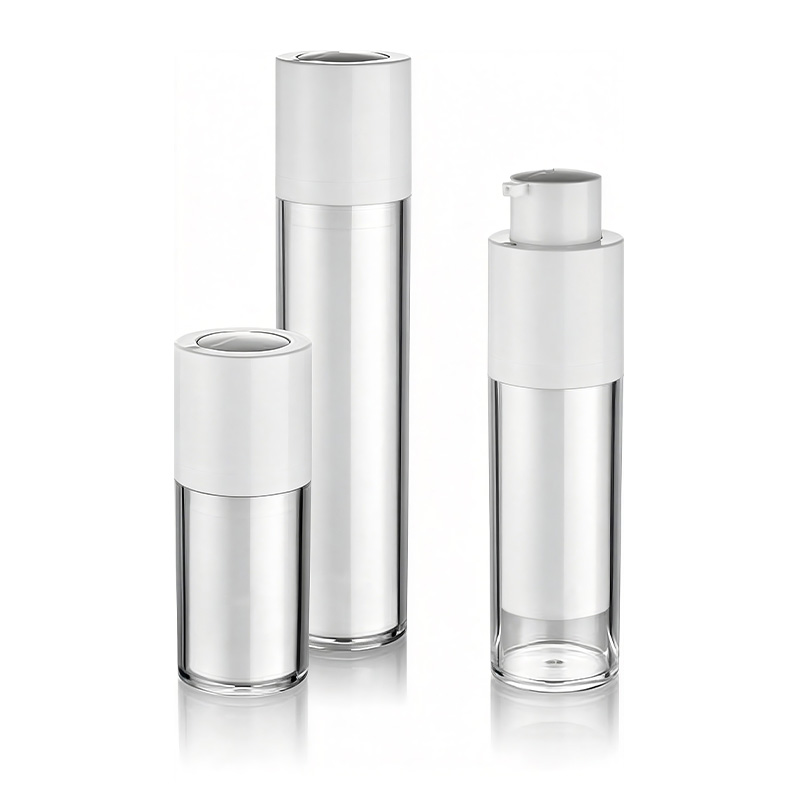 Plastic Replacable Airless Bottle1. Volume Available: Available in 15g, 30g, and 50g, offering versatile packaging options for different quantities of cream or facial care products.View Product →
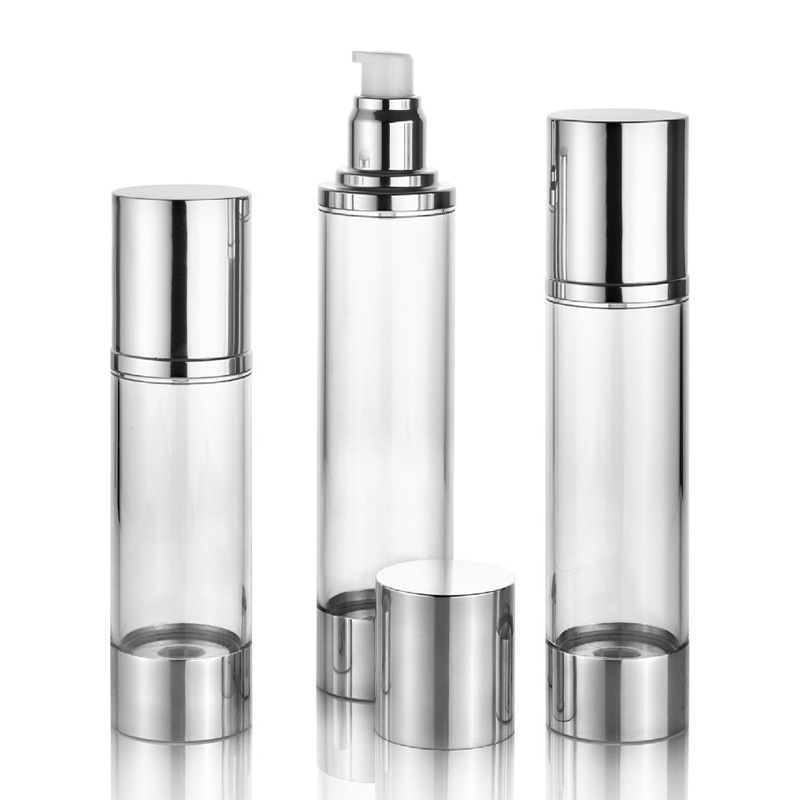 Aluminium Airless Serum Pump Bottle1. Volume Available: Available in 15g, 30g, 40g, and 50g, offering a range of sizes to suit different product quantities and consumer preferences.View Product →
Sourcing Risks Worth Testing Before You Commit
Airless packaging has a narrow tolerance band, and most complaints trace back to one of five issues. Run these checks during sampling, not after the first container ships:
- Over-filling: leaving too little head space traps air under the valve and every dose comes up short. Fill by weight, then verify by stroke count.
- Piston stick-slip: a piston that jumps rather than glides delivers uneven doses and, on a translucent body, visible product smearing.
- Leakage at the seal: temperature cycling between 4 °C and 45 °C exposes weak sealing before shipping does.
- Actuation force: above roughly 30 N, users with weaker grip stop pressing fully and the bottle appears defective.
- Formula compatibility: an eight to twelve-week stability test with product inside the actual bottle is the only reliable evidence.
How to Brief a Supplier in One Email
- Nominal fill volume in millilitres, plus the maximum fill you would ever run.
- Formula type and apparent viscosity, measured at your filling temperature.
- Required dose per stroke, with an acceptable tolerance band.
- Target bottle diameter and height, or the shelf space you must fit.
- Decoration method, colour reference and whether a refill version is planned.
- Regulatory market, because labelling and material declarations differ by region.
- Annual volume and first order quantity, which decide tooling and mould layout.
- Delivery window and destination port.
Airless pump makeup packaging is a mechanical system, not a decorative bottle. Decide the dose first, then the piston and seal material, then the finish — in that order the project stays short. Sourcing teams that lock the look before the dose usually end up paying for a second mould.
If you are comparing formats or need samples with a specific dose and wall material, our team can quote against your fill volume and stability requirements. You can reach the packaging engineers directly through our contact page, and we will usually come back with a comparable build and a sampling plan within one working day.
-
What's Inside a Lotion Pump and How Does It Work ?
A lotion pump is a precision dispensing closure that draws liquid product from a bottle and delivers...
-
Airless Bottles Uncovered: How to Protect Your Skincare and Perfect Every Pump
If you have ever opened a pump bottle of serum and found the last quarter of the product impossible ...
-
How Glass Airless Bottle Packaging Prevents Contamination and Boosts Shelf Life?
Glass airless bottle packaging prevents contamination and extends shelf life by completely eliminat...
-
What is a Perfume Crimp Pump and Why Use It?
What Is a Perfume Crimp Pump and Why Use It? A perfume crimp pump is a precision liquid dispensing ...
Copyright © GreenYard Tools Co.,ltd. All Rights Reserved.
Personal Care Packaging Manufacturer Custom Perfume Sprayers Factory