
-
About Us
Why Choose Us?The company possesses advanced capabilities in mold design, injection molding, and automated assembly, supported by a professional quality inspection team to ensure product reliability. A dedicated design team continuously drives product innovation, providing customers with high-quality spray solutions.
 Coming From China, Marketing To The World.
-
Products
-
News
 English
 Français
 русский
 Español
Roll On Bottles: Types, Refill Guide, and Packaging Buying Tips for Your Brand
Content
The first sample rolled smoothly, the second clicked, and the third leaked after ten presses. Three roll-on bottles from three suppliers, all described as suitable for deodorant, behaved completely differently on the filling line and on the skin. The practical conclusion is simple: on a roll-on bottle, the ball, the seat, and the cap tolerance decide quality — everything else is decoration. A good roll-on bottle lets the ball rotate freely, spreads a thin layer of liquid evenly, and keeps the formula sealed even when the bottle lies sideways in a gym bag for hours.
That is why the roll-on bottle is one of the more demanding packaging formats in cosmetics. It looks like a plain bottle with a sphere on top, yet the steps that matter — ball selection, neck forming, gasket assembly, cap torque — are invisible to the consumer until the product leaks or the ball locks. Knowing these parts helps you judge a supplier, refill a bottle correctly, and choose between plastic and glass before you place an order.
What Makes a Roll-On Bottle Work
The ball is a mechanical applicator, not a cap. When the bottle is tilted, the ball dips into the liquid, picks up a thin film on its surface, and transfers it to the skin as it rolls. A sealing ring between the ball and the bottle neck keeps the liquid inside and holds the ball in position. If the ring is too soft, the ball drags; if the ball is too small for the opening, the bottle leaks around the rim.
Most plastic roll-on bottles in production use a PP or PE ball between 20 and 32 mm in diameter. Stainless steel balls are a common upgrade for high-alcohol formulas and for filling processes that need higher heat resistance. Capacity typically ranges from 10 ml to 100 ml, and the standard sizes for deodorant are 30 ml, 50 ml, and 75 ml. For perfume and essential oil blends, 10 ml to 30 ml formats are often preferred.
 30ml and 60ml Plastic Deodorant Roll-on Bottle with Removable BallThis bottle simplifies filling and refilling with a one-piece body and removable ball. Ideal for deodorant brands, it ensures consistent neck diameter, thread, and wall thickness for reliable production.View Product →
For a deodorant brand filling a liquid formula, a plastic deodorant roll-on bottle with a one-piece body and a removable ball simplifies both filling and refill. Your QC team will need consistency in three places: the inner neck diameter that accepts the ball, the thread that holds the cap, and the wall thickness that survives a drop test during distribution.
If the formula is solid rather than liquid, the roll-on concept stops working. A twist-up stick container replaces the ball and the liquid path with a push-up dosage platform — a different packaging logic, but the same supply decision for a deodorant brand.
 8g Plastic Deodorant Stick Bottle for Solid Cosmetics and Lip BalmCompact stick packaging for solid formulas like deodorant, lip balm, or blush. Customizable with screen printing or hot stamping, it offers an efficient and hygienic dispensing solution.View Product →
Plastic vs. Glass Roll-On Bottles: Material Changes the Performance
Material is the first decision a packaging engineer makes for a roll-on line. Plastic and glass differ in weight, drop resistance, chemical compatibility, and decoration flexibility. The comparison below highlights the points that actually affect filling, transport, and consumer use.
| Criteria | Plastic (PP/PE/PET) | Glass |
|---|---|---|
| Weight (50 ml size) | 15–25 g | 60–90 g |
| Drop resistance | Survives a 1–2 m drop in most cases | Requires protective outer packaging |
| Alcohol compatibility | Good with short-chain alcohols; monitor essential-oil permeation | Excellent barrier, very low permeation |
| Decoration | Silk-screen, IML, hot stamping, spray coating | Frosting, spraying, silk-screen |
| Typical volumes | 30, 50, 75, 100 ml | 5, 10, 15, 30 ml |
| Common uses | Deodorant, cologne, body mist | Perfume, essential oils, prestige serum |
For high-volume deodorant production, plastic is usually the practical choice: it survives distribution without extra packaging, lowers shipping weight, and keeps the bottle recyclable in mono-material structures. For prestige perfume and essential oil lines, glass provides the evaporation barrier that resins cannot match, especially for low-viscosity blends containing 60–80% alcohol.
Plastic roll-on bottles are no longer limited to plain white functional bodies. A plastic full-range roll-on bottle for perfume can be molded with a smooth surface that accepts silk-screen printing, spray coating, or a metallic finish, which widens the design range without switching to glass.
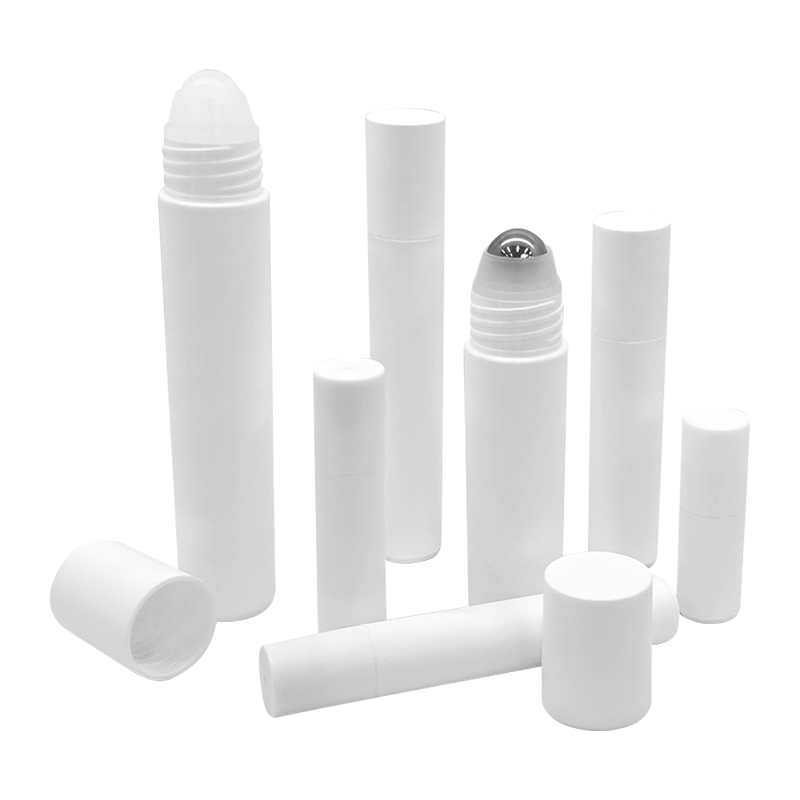 Plastic Full Range Roll-on Bottle for Perfume and Essential OilsAvailable in 3ml to 30ml sizes, this bottle suits portable perfumes, insect repellent, and skincare liquids. Its durable ball seat supports refilling without deformation, ideal for on-the-go use.View Product →
How to Refill a Roll-On Bottle Without Damaging the Seal
Refilling is routine for essential-oil roller bottles and refillable deodorant lines. The most common failure is not dirty liquid; it is deformation of the ball seat. When the ball is pried out carelessly, the plastic or metal seat bends, and the reinserted ball no longer contacts the seal evenly.
Step-by-Step Refill Process
- Wash the bottle, cap, and ball with warm water and mild detergent; rinse and dry every component completely.
- Remove the ball by pressing it out from the underside of the neck. For threaded ball caps, unscrew slowly so the ball does not pop out.
- Fill the bottle to 80–90% of its volume. The air pocket above the liquid lets the ball pick up product on the next turn.
- Press the ball back into the seat and turn the bottle upside down. A correct fit allows the ball to rotate under light finger pressure without falling out.
- Lay the filled bottle on a tissue for 4–6 hours. Any wet mark around the rim means the seat or gasket needs replacement.
Not every roll-on bottle is designed for repeated refills. Mono-material plastic bottles with a pressure-held ball open and close cleanly many times; crimped aluminum neck assemblies do not. If refills are part of the business model, state that requirement in the technical data sheet before ordering.
Viscosity changes the refill behavior too. A thin alcohol-based perfume creeps along the gap between ball and ring and evaporates faster, so the gasket material must resist alcohol. A thicker water-in-oil deodorant rolls smoothly but needs a slightly larger ball opening. Test the actual formula with the actual ball and ring at the sampling stage. When the bottle finally reaches the end of its useful life, disposal depends on how the parts are joined; a practical breakdown of what curbside recycling accepts is available in this guide to deodorant container recycling.
Five Defects That Appear on Low-Cost Roll-On Bottles
When delivery samples from multiple suppliers are inspected side by side, the same five defects repeat. They are measurable, and they belong in the incoming QC checklist.
- Ball seat flash. A small burr left inside the seat makes the ball click or lock during the first rotations.
- Ball tolerance drift. Diameter varies more than 0.1 mm between batches, producing sticky or loose balls on the same neck.
- Inconsistent gasket compression. The ball does not press the gasket uniformly, so the bottle leaks after lying on its side for eight hours.
- Cap torque variation. Caps loosen during transport, and the alcohol fraction escapes through the thread area.
- Neck ovality. The neck ring is not round, so the ball cannot contact the sealing surface evenly around the full circumference.
These defects translate into concrete acceptance criteria. A functional roll-on bottle should allow the ball to rotate one to three turns with light finger pressure, show no liquid after 24 hours in a horizontal position, and survive a 1.5 m drop on hard concrete for plastic bodies. Put these numbers in the quality agreement instead of relying on a general "no leakage" clause.
What to Verify When You Source Roll-On Bottles From a Factory
Buying from a trading company is different from working with the injection-molding plant that actually makes the part. The right question is not "can you produce a 30 ml roll-on bottle?" but "what mold, what machines, and what tolerances do you hold?"
The manufacturer behind this site is an integrated packaging supplier with in-house mold design, injection molding, and automated assembly lines, and it applies ISO 9001 controls from raw material to finished product. The 20,000 m² facility produces roughly 1 million pieces per day, and the company reports a batch pass rate above 99.5% for key processes. For a packaging buyer, these numbers matter because roll-on bottles fail at the interface between molding precision and assembly consistency. The complete roll-on bottle range, including deodorant-style bodies and perfume-oriented designs, is listed in the product catalog.
Customization usually affects four variables: bottle color and surface finish, cap style, ball material and size, and decoration printing. Whether you place a standard order or a custom tooling project, request a horizontal leak test report and a ball rotation sample at the trial-run stage, not after mass production starts.
For a new deodorant or perfume line, start with a 50 ml plastic roll-on bottle, specify ball and gasket compatibility with your formula, and confirm the cap torque range with your filling line. Those three tests cost almost nothing and prevent most of the complaints that come back from the market.
-
Trigger Sprayer Guide: How It Works, Types & Buying Tips
What Is a Trigger Sprayer A trigger sprayer is a mechanical pump closure mounted on a bottle neck t...
-
Aerosol vs Spray: Key Differences, Packaging Choices, and Practical Buying Tips
Two quotations land on a packaging buyer's desk. One is a pressurized aerosol can; the other is a m...
-
Airless Bottles Uncovered: How to Protect Your Skincare and Perfect Every Pump
If you have ever opened a pump bottle of serum and found the last quarter of the product impossible ...
-
What Makes a Good Deodorant Stick Bottle for Brands?
A deodorant stick bottle is a twist-up or push-up dispensing container designed to hold and advance...
Copyright © GreenYard Tools Co.,ltd. All Rights Reserved.
Personal Care Packaging Manufacturer Custom Perfume Sprayers Factory