
-
About Us
Why Choose Us?The company possesses advanced capabilities in mold design, injection molding, and automated assembly, supported by a professional quality inspection team to ensure product reliability. A dedicated design team continuously drives product innovation, providing customers with high-quality spray solutions.
 Coming From China, Marketing To The World.
-
Products
-
News
 English
 Français
 русский
 Español
Continuous Mist Bottle Buying Guide: Pre-Compression Pumps and Mist Specs
Content
- 1 How a continuous mist bottle stores pressure before it sprays
- 2 Continuous mist, standard trigger or fine mist sprayer: matching the build to the job
- 3 The specification sheet that survives a line trial
- 4 Where the continuous format earns its unit cost
- 5 Failure modes to test before approving the drawing
- 6 A sourcing sequence that keeps the project on schedule
A buyer presses the trigger on a continuous mist bottle and holds it: the mist runs unbroken for several seconds, at nearly the same pressure from the first moment to the last. Press a standard trigger sprayer the same way and the spray pulses with each stroke, thinning as the hand tires.
The difference is not a stronger spring. It is a chamber that stores pressure before the nozzle ever opens, and that changes almost every number a packaging buyer needs on the drawing: stroke volume, charge strokes, spray duration, particle size, vent size and spring material. Specify those six and most samples pass the first line trial. Leave them to the factory default and you inherit the two failures that keep reappearing in this category — a sputtering tail at the end of each charge, and seepage around the vent after a few hundred cycles.
How a continuous mist bottle stores pressure before it sprays
Pre-compression is the mechanism behind most "continuous" claims. The first part of the trigger stroke pushes liquid through a one-way inlet valve into a small accumulator. A spring-loaded discharge valve stays shut until pressure inside that chamber reaches its cracking point, typically 2 to 4 bar. Above that point the valve opens, and the nozzle keeps emitting until pressure falls back below the threshold. The user feels one smooth discharge rather than a pulse per stroke.
Two families use the same idea in different places:
- Accumulator triggers hold the chamber downstream of the piston, so the bottle itself stays at atmospheric pressure. One or two priming strokes are enough, and the discharge usually lasts 3 to 6 seconds.
- Bottle-pressurised misters pump air into the headspace instead. The liquid leaves through the dip tube under stored air pressure, which keeps spraying at any angle until the pressure decays, but the closure now needs a relief valve or vent.
The first family is cheaper to tool and easier to decorate. The second wins wherever the user sprays upside down or has limited grip strength — sun care, hair care, cleaning under furniture. Choosing between them is a decision about the use case, not about which one is technically superior.
If you are still weighing trigger geometry and orifice variants, our trigger sprayer guide walks through the valve layouts in more detail.
Continuous mist, standard trigger or fine mist sprayer: matching the build to the job
Three formats get called "continuous mist" in quotations and sample boxes, and they behave very differently once a consumer holds them. The table below shows where each one usually lands on output and on cost.
| Build | What the user feels | Typical output | Strongest use case | Trade-off |
|---|---|---|---|---|
| Standard trigger sprayer | Pulsing spray, effort on every stroke | 0.9–1.3 mL per stroke | General household cleaning | Uneven coverage; hand fatigue on large areas |
| Pre-compression continuous trigger | Smooth mist for 3–6 seconds per charge | 0.7–1.1 mL per stroke | Sanitiser, surface care, pet grooming | More parts, tighter tolerances, higher tooling cost |
| Pressurised continuous mist bottle | Pump the cap, then spray for minutes | Depends on headspace and nozzle | Hair care water mist, plant care, detailing | Pressure fades near empty; venting must be designed |
| Fine mist sprayer (pump action) | A single fine burst per press | 0.05–0.15 mL per press | Perfume, facial mist, nasal care | Short burst only; no sustained stream |
Cost follows part count. A pre-compression trigger usually carries two to four more moulded components than a plain trigger, and that shows up in tooling amortisation and unit price. It pays back where even, repeatable coverage matters — sanitising a large desk, coating a vertical surface — and rarely pays back on a product used in two-second bursts.
The specification sheet that survives a line trial
Most disputes in this category start with a loose drawing. A sample that "felt right" in a meeting is not a specification, and factories will default to whatever their current tool produces. These are the headings worth writing down.
Output and duration
State stroke volume to within ±0.1 mL, the number of priming strokes before first spray (1 to 2 is typical), and the discharge duration per charge. Also set a limit on the tail: the final fraction of a second when the mist degrades into coarse droplets. Buyers who ignore the tail hear about "spitting" from consumers three months after launch.
Particle size and spray angle
A D50 between 40 and 90 µm reads as mist to most users; above roughly 120 µm it starts to feel like a squirt. Spray angles of 60 to 90 degrees suit flat surfaces, narrower cones suit targeted work. Test with the real formula, not water — 20% alcohol or a 1% surfactant load shifts both numbers noticeably.
Closure, dip tube and venting
28/410 and 24/410 remain the common necks, but a continuous trigger often needs extra neck width for the accumulator and a defined vent path. Specify dip tube length so the tube sits 2 to 3 mm above the base, and require the vent to close when the bottle is inverted or laid on its side.
Material compatibility
PP bodies with POM valve parts are standard. High-alcohol sanitiser swells some grades, and essential oils attack low-density dip tubes over several months. Ask for the spring grade in writing — stainless, coated steel or plastic — because a corroded spring is the quiet cause of many pressure losses on the shelf.
Where the continuous format earns its unit cost
Hair care is the clearest case: a continuous water mist lets someone refresh curls or dampen hair for styling without pumping twenty times, and the even coverage matters more than the fluid volume. Sunscreen sprays and after-sun mists live on the same benefit, plus the ability to spray at an angle.
In sanitising and home care the gain is speed and coverage on vertical surfaces — fewer drips, less runoff, one pass instead of four. Mini trigger formats are usually the practical answer when the pack has to be pocket-sized or travel-friendly.
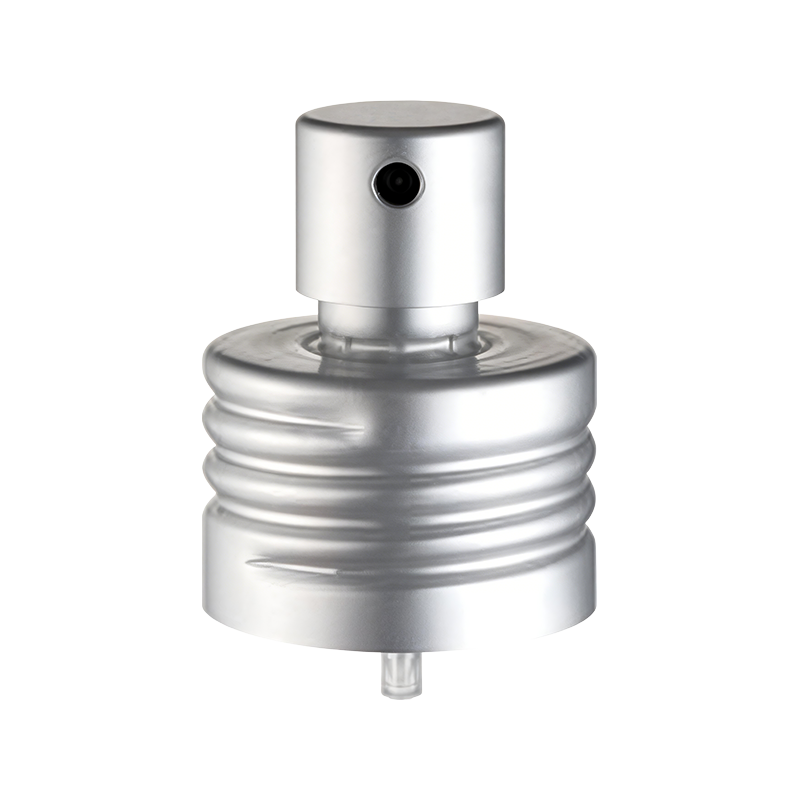
 GY-109A3 Mini Trigger Mist Sprayer for SanitizersCompact 24mm mini trigger delivers a fine, even mist at 0.25 ml per spray for sanitizers, air fresheners, and travel-friendly packs.View Product →
For larger surface areas, an ultrafine trigger produces a wider, softer cone that wets the surface evenly instead of spotting it, which matters when the formula leaves visible residue.
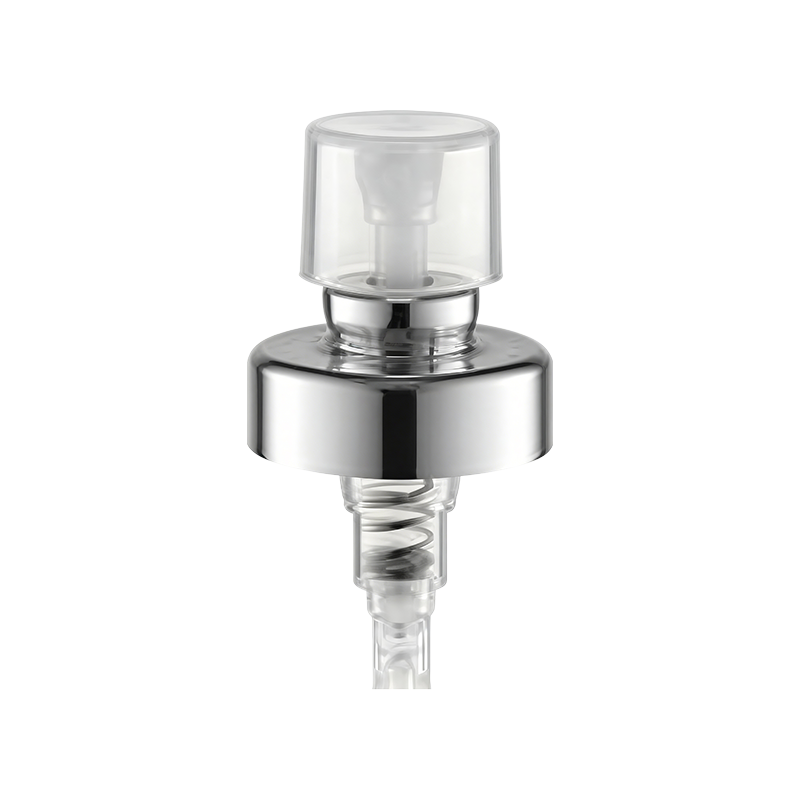
 GY-105A1 Ultra-Fine Trigger Sprayer for Cleaning and Care28mm ultra-fine trigger dispenses 0.3 ml per spray in a uniform mist for house cleaning, disinfection, skincare, and plant care.View Product →
Where the product is a perfume, facial mist or targeted treatment rather than a surface spray, the pump-action fine mist format still gives the finest droplets per press; the accumulator simply is not needed.
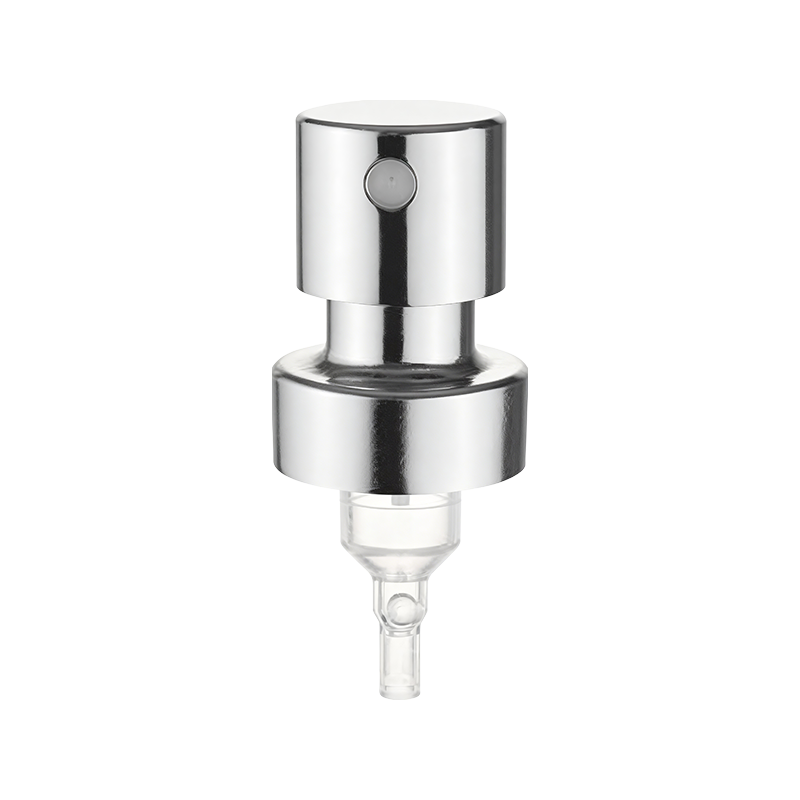
 GY-610P 0.7CC External Spring Fine Mist SprayerHigh-output 0.7 ml per stroke with external spring and customizable dip tube for fragrance, body mist, pharmacy, and household formulations.View Product →
Failure modes to test before approving the drawing
Five problems account for most field returns in this category, and each one can be reproduced on a bench in a few days:
- Sputter at the end of the charge — usually a chamber volume too small for the required duration.
- Weeping at the vent after repeated cycles — a vent seal that relaxes once the spring takes a set.
- Output decay after a few thousand strokes — abrasion of the piston cup or a partly blocked orifice.
- Corrosion or swelling with aggressive formulas — wrong spring alloy or wrong elastomer.
- Leakage in transit — neck thread tolerance that passes a bench test but fails after a 1.2 m drop and two weeks at 45 °C.
A workable protocol is 50,000 dry strokes on five units, a 24-hour inverted leak test at 45 °C, a freeze-thaw cycle, and a compatibility check with the finished formula rather than water. Record the discharge duration at stroke 1, 1,000 and 50,000; if the number drifts by more than 20%, the valve design needs another look.
A sourcing sequence that keeps the project on schedule
- Fix the formula first — viscosity, pH, alcohol content, surfactant load — before requesting any sample.
- Ask for a 2D drawing with tolerances on neck T and E dimensions and on chamber volume, not just a reference sample.
- Request 30 samples from production tooling; lab-tooled parts hide gate and weld-line differences.
- Run the cycle and compatibility tests before approving decoration, because coatings change the grip and the trigger feel.
- Confirm MOQ, tooling ownership, reorder lead time and packing specification in writing, and keep a signed golden sample on both sides.
Timelines usually hinge on the drawing rather than the mould: a clear specification with agreed tolerances shortens sampling from several rounds to one or two, and it gives both teams something concrete to compare against when a complaint arrives.
Continuous mist is a pressure-storage problem before it is a spray problem. Decide which format suits the use case, write stroke volume, duration, particle size, venting and spring material into the drawing, and test the tail as carefully as the first second of spray. That combination is what separates a pack that feels premium in the hand from one that splutters three weeks into a launch.
If you are weighing accumulator triggers, bottle-pressurised misters or a fine mist pump for a specific formula, send our packaging team the viscosity, alcohol content and target output — we will come back with the matching build and a sample plan.
-
Roll On Bottles: Types, Refill Guide, and Packaging Buying Tips for Your Brand
The first sample rolled smoothly, the second clicked, and the third leaked after ten presses. Three...
-
Misting Spray Bottle Guide: How a Fine Mist Sprayer Works
Quick Answer: What Makes a Misting Spray Bottle Work Well A misting spray bottle performs well when...
-
How Glass Airless Bottle Packaging Prevents Contamination and Boosts Shelf Life?
Glass airless bottle packaging prevents contamination and extends shelf life by completely eliminat...
-
Spray Bottles Explained: Choosing the Right Fine Mist Sprayer
What Makes a Good Spray Bottle A good spray bottle depends almost entirely on the quality of its pu...
Copyright © GreenYard Tools Co.,ltd. All Rights Reserved.
Personal Care Packaging Manufacturer Custom Perfume Sprayers Factory