
-
About Us
Why Choose Us?The company possesses advanced capabilities in mold design, injection molding, and automated assembly, supported by a professional quality inspection team to ensure product reliability. A dedicated design team continuously drives product innovation, providing customers with high-quality spray solutions.
 Coming From China, Marketing To The World.
-
Products
-
News
 English
 Français
 русский
 Español
The Strategic Importance of Refillable Containers for Skincare Products
Content
- 1 Three Measurable Benefits, Not Just a Green Label
- 2 The Cost and Logistics Math Behind Refill Systems
- 3 How Refills Change Repeat Purchase Behaviour
- 4 The Engineering Requirements Most Refill Projects Underestimate
- 5 Material Choices That Keep Refills Genuinely Recyclable
- 6 A Buyer's Checklist Before You Approve a Refill Mould
- 7 When a Refill Programme Is the Wrong Move
A 50ml cream in a single-use glass jar with a pump weighs roughly 118 grams before it ever reaches a customer. The same cream shipped as a refill cartridge weighs about 22 grams. That gap, not the sustainability line on the label, is the number that moves a packaging budget, and it explains why refillable containers have moved from a niche experiment into standard skincare product development.
The catch is that the same gap decides the risk. A refill that leaks at the third open-close cycle, or that cannot hold a consistent dose after a 40°C shipping lane, will cost more in returns than it saves in resin. Below is where the benefits are real, what has to be engineered, and how to screen a refill system before you commit to a mould.
Three Measurable Benefits, Not Just a Green Label
Start with the conclusion: refillable skincare containers pay off in three places, which are material cost per use, freight cost per unit, and repeat-purchase frequency. If a refill programme cannot show improvement in at least two of those three, it is a marketing gesture rather than a supply-chain decision.
On material, a standard 50ml glass or PET jar paired with an airless pump uses roughly 110 to 130g of packaging. A compatible refill cartridge typically uses 20 to 30g of plastic. That is a 70 to 80 percent reduction in resin per consumer cycle, and it repeats every time the customer refills instead of rebuying.
On freight, weight is the variable that decides how many units fit into a container. Lighter refills mean more units per shipment, lower per-unit freight, and less breakage exposure on long ocean lanes.
On retention, the hardware is bought once and the formula is bought repeatedly. That single structural difference changes how a brand prices the product, forecasts demand, and plans its next production run.
The Cost and Logistics Math Behind Refill Systems
The table below uses typical 50ml cream specifications. Real numbers shift with wall thickness, decoration, and the pump platform you select, but the direction stays consistent across categories.
| Metric | Single-Use Primary Pack | Refill Cartridge |
|---|---|---|
| Packaging weight per unit | About 118 g | About 22 g |
| Resin used per 1,000 units | About 95 kg | About 18 kg |
| Units per 40HQ container | About 96,000 | About 420,000 |
| Ocean freight per 1,000 units | Around USD 85 to 95 | Around USD 20 to 25 |
| Customer reorder action | Buy a full pack | Buy a refill |
Read the container-loading row together with the freight row. A roughly five-fold difference in units per container is not a rounding error, and it is the part of the calculation most brands miss because they compare piece price instead of landed cost per use.
One caution: refills are not automatically cheaper at the unit level. The outer vessel often costs more per piece than a plain bottle, because it needs a stronger wall, a more precise locking geometry, or a thicker decorative shell. The savings come from the repeated cycle, not from the first order.
How Refills Change Repeat Purchase Behaviour
The first purchase is the container, and every later purchase is the formula. That is the whole behavioural shift, and it is why refill programmes appear most often in categories with frequent, predictable use.
Daily face cream, body lotion, treatment serums, and deodorant all qualify, because customers finish them in six to ten weeks and are willing to reorder when the outer pack still looks good on the shelf. Stick formats also show the model clearly: a 30 to 50g stick housing can last a year or more while the inner cartridge is replaced every two months, so the shell carries the brand look and the cartridge carries the usage and the cost.
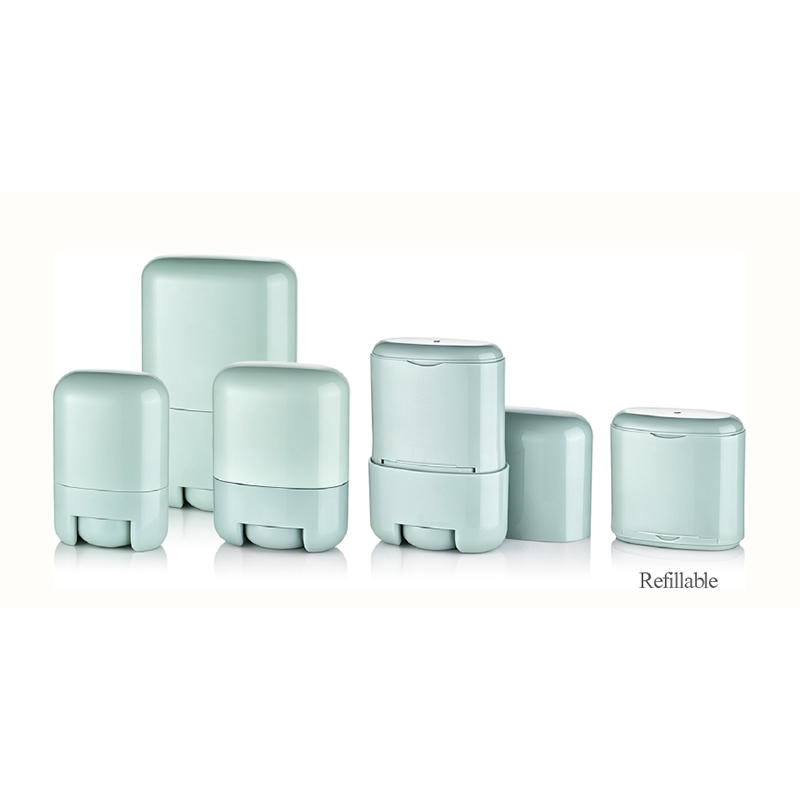 Refillable Deo-Stick Cosmetic Packaging Container with Built-In BrushRefillable deo-stick packaging for body glow sticks, concealers, and balms, with built-in brush and four capacity options for repeat-use formats.View Product →
Pricing usually follows the same logic. A brand may sell the outer vessel at a premium once, then price refills noticeably lower, which converts a one-off transaction into a predictable reorder stream without re-educating the customer on how the product works.
The Engineering Requirements Most Refill Projects Underestimate
Most refill projects do not fail on the concept. They fail on the seal.
A refillable container has to open and close repeatedly while keeping an airtight boundary, which means three specifications have to be locked down early: the mating tolerance of the locking clips, usually kept within 0.1 to 0.2mm; the compression set of the sealing lip, which must still return after ten removal cycles; and the stroke position of the pump or nozzle, so the delivered dose stays constant as the cartridge is seated and removed.
 Refillable Airless Bottle for Facial Care and CreamsAirless bottle in 15g, 30g, and 50g sizes with snap-on closure and replaceable inner cartridges for creams, serums, and facial care.View Product →
Airless formats raise the bar further. The refill has to seat the piston correctly so the internal vacuum is not broken; a cartridge that sits 1mm off can lose more than 20 percent of its dose accuracy. Studying how an airless bottle system keeps a refill airtight before modifying a structure is usually more reliable than designing a vacuum path from scratch.
Material Choices That Keep Refills Genuinely Recyclable
A refill only delivers half its environmental value if it cannot be recycled after use. The most practical route is to select components by material family: a PP vessel with a PP pump and PP collar, or a PET bottle with a PET pump. Once a metal spring or steel ball enters the assembly, the part must be disassembled, and in real recycling conditions that rarely happens.
 All-Plastic Lotion Pump with 2.0ml DosageAll-plastic lotion pump with 2.0ml dosage, 24-410/28-410 necks, no metal spring or glass ball, suitable for shower gel and lotion.View Product →
All-plastic dispensing platforms, including single-material pumps without metal springs, exist for exactly this reason. They keep wall thickness in a conventional range and remove the need for sorting at the end of life.
Two more details decide whether the claim holds up. First, label and decoration choice: sleeves and adhesives that cannot be separated contaminate the recycled stream. Second, post-consumer recycled content. If the cartridge uses 30 percent PCR but the outer vessel is virgin resin, state the content on both parts, because users read the product as one pack.
A Buyer's Checklist Before You Approve a Refill Mould
- Verify dose accuracy across the full cartridge, not just the first fill, and hold it within roughly five percent of nominal.
- Request the sealing lip cross-section and the retention figure after repeated removal cycles.
- Run at least ten open-close cycles on sampled units and record leakage, dose, and cosmetic condition at each stage.
- Simulate shipping: 72 hours at 50°C, then a one-metre drop, checking for leakage, cracking, and piston movement.
- Confirm formula compatibility by ageing the cartridge and pump in contact with the product for four weeks at 40°C, especially for oil-rich serums.
- Agree the recycling path in writing: material family, adhesive choice, metal content, and PCR percentage per component.
- Build a full cost model covering the vessel, the cartridge, freight, and the return rate the refill design is expected to carry.
If your team has no in-house packaging engineering resource, put these seven points directly into the RFQ and ask the supplier to submit samples against your dimensions and leak criteria. You can start that conversation on our contact page, where the team reviews mould, material, and assembly requirements before a project is quoted.
When a Refill Programme Is the Wrong Move
Three situations argue for delaying or abandoning a refill design. If the unit dose is below 15ml, the material saved by a cartridge may not cover the cost of the extra locking geometry and the additional tooling. If the formula is highly oxidation-sensitive and the only proven dispensing route still depends on a metal spring, fix the preservation system first. If the outer vessel has not yet been finalised, changing the bottle itself is usually cheaper than adding a refill interface to a structure that was never designed for one.
The practical screen is simple: build a three-year packaging cost model that includes resin, freight, returns, and end-of-life handling. If the refillable route does not lead over two purchase cycles, improve the primary pack first, build volume, and return to the refill question when the numbers support it.
-
The Secret to Perfect Skincare Dosing: Choosing the Right Dropper Bottle
The dropper bottle is one of the most familiar formats in skincare — and one of the most underestima...
-
Provide You With The Latest Enterprise And Industry News.
We are more than just a packaging manufacturer; we are a trusted partner in your supply chain. With...
-
Crimp Pumps Demystified: Choosing the Right Type and Material for Every Cosmetic Formula
Walk into any cosmetic filling facility and you will find crimp pumps on everything from a delicate ...
-
Airless Bottles Uncovered: How to Protect Your Skincare and Perfect Every Pump
If you have ever opened a pump bottle of serum and found the last quarter of the product impossible ...
Copyright © GreenYard Tools Co.,ltd. All Rights Reserved.
Personal Care Packaging Manufacturer Custom Perfume Sprayers Factory