
-
About Us
Why Choose Us?The company possesses advanced capabilities in mold design, injection molding, and automated assembly, supported by a professional quality inspection team to ensure product reliability. A dedicated design team continuously drives product innovation, providing customers with high-quality spray solutions.
 Coming From China, Marketing To The World.
 -
Products
-
News
 English
 Français
 русский
 Español
How the Treatment Cream Pump Enhances the Consumer Skincare Experience ?
Content
- 1 Precise Dosage Control Eliminates Waste and Ensures Consistent Results
- 2 Hygienic Dispensing Protects Formula Integrity Over Time
- 3 Ergonomics and Ease of Use Shape the Daily Ritual
- 4 Material Compatibility Ensures the Pump Works With Your Formula
- 5 Sustainable and Customizable Pump Options Support Brand Differentiation
- 6 What to Evaluate When Sourcing a Treatment Cream Pump
- 7 Conclusion: The Pump Is Part of the Product Experience
A treatment cream pump does more than dispense product — it fundamentally shapes how consumers interact with a skincare formula from the very first press. Unlike open jars or screw-cap tubes, a well-engineered treatment pump delivers a controlled, hygienic dose every time, preserving formula integrity and making the application ritual feel effortless and precise. For brands and consumers alike, the pump is not an afterthought: it is a critical interface between the product and the skin.
This article explores how the design, mechanics, and ergonomics of a treatment cream pump translate directly into a superior skincare experience — covering dosage accuracy, formula protection, ease of use, and what to look for when evaluating pump quality for B2B sourcing decisions.
Precise Dosage Control Eliminates Waste and Ensures Consistent Results
One of the most tangible benefits of a treatment cream pump is metered dispensing. Each actuation delivers a fixed volume — typically between 0.5 ml and 1.5 ml depending on pump specification — so consumers apply the correct amount of active ingredients without guessing. Over-application of potent actives such as retinoids, peptides, or exfoliating acids can cause irritation; under-application reduces efficacy. A calibrated pump removes both risks.
From a product-use perspective, consistent dosing also means the consumer's supply lasts exactly as intended. This builds trust in the brand's value proposition and reduces the likelihood of returns or complaints driven by unexpected product depletion.
Dosage output per stroke varies by pump type. The table below summarizes typical output ranges across common pump formats used in skincare:
| Pump Type | Typical Output per Stroke | Common Application | Viscosity Suitability |
|---|---|---|---|
| Standard Lotion Pump | 1.0 – 1.5 ml | Moisturizers, serums | Low to medium |
| Treatment Cream Pump | 0.5 – 1.0 ml | Rich creams, balms, actives | Medium to high |
| Airless Pump | 0.3 – 0.5 ml | Anti-aging, sensitive formulas | Low to high |
| Fine Mist Pump | 0.1 – 0.2 ml | Toners, facial mists | Very low |
Hygienic Dispensing Protects Formula Integrity Over Time
Treatment creams — particularly those formulated with antioxidants, vitamins, or biologically active peptides — are highly susceptible to oxidation and microbial contamination. Every time a consumer opens a jar and inserts a finger, they introduce oxygen, bacteria, and environmental pollutants directly into the product. Over weeks of daily use, this degrades active ingredient potency and shortens shelf life.
A closed-system treatment pump eliminates direct contact between the formula and the consumer's hands or the ambient environment. The product exits through a sealed nozzle only when dispensed, maintaining a stable internal atmosphere between uses. For airless pump variants, a rising piston mechanism further prevents air ingress, making them particularly suitable for oxygen-sensitive actives.
This hygiene advantage is especially relevant in professional skincare lines, clinical-grade formulations, and products marketed toward sensitive skin consumers, where formula stability is directly tied to safety and efficacy claims.
Ergonomics and Ease of Use Shape the Daily Ritual
The skincare routine is a daily habit — and the ease with which a consumer can complete that habit influences both compliance and brand loyalty. A treatment cream pump that requires excessive actuation force, drips after dispensing, or clogs with thick formulas creates friction at a moment that should feel effortless and even luxurious.
Key ergonomic factors that define the consumer experience include:
- Actuation force: The pressure required to depress the pump head. Lower actuation force (typically 20–40 N for cream pumps) reduces hand fatigue, particularly important for older consumers or those with reduced grip strength.
- Nozzle geometry: A well-designed nozzle directs cream precisely onto fingertips or applicators without dripping onto the bottle neck or cap interior.
- Lock mechanism: A twist-lock or press-lock feature prevents accidental dispensing during travel or storage, keeping the product clean and preventing waste.
- Stroke height and head stability: A pump head that compresses smoothly and returns firmly to position signals quality to the consumer at every use.
- Dip tube length: A correctly calibrated dip tube ensures near-complete product evacuation, reducing formula left behind in the bottle — a practical benefit consumers notice and appreciate.
Together, these elements make the act of dispensing feel intentional and premium, reinforcing the product's perceived value at every interaction.
Material Compatibility Ensures the Pump Works With Your Formula
Not all treatment pumps are compatible with all formulations. The internal components — springs, gaskets, valves, and dip tubes — are typically manufactured from polypropylene (PP), polyethylene (PE), or stainless steel, each with different compatibility profiles.
For B2B buyers evaluating pumps for specific formulas, the following compatibility considerations are essential:
- Oil-rich and anhydrous formulas may degrade standard rubber gaskets; silicone or EPDM gaskets offer better resistance.
- High-active or low-pH formulas (such as vitamin C or AHA-based creams) require chemical-resistant internal components to prevent leaching or pump degradation.
- Very thick or wax-based creams require larger orifice diameters and stronger spring mechanisms to maintain reliable actuation without clogging.
- Natural and preservative-free formulas benefit most from airless pump systems that minimize oxidation exposure throughout the product's life cycle.
Conducting compatibility testing between the pump and the finished formula — including accelerated stability studies — is a standard step before finalizing packaging for any treatment cream product.
Sustainable and Customizable Pump Options Support Brand Differentiation
As sustainability becomes a core procurement criterion for global skincare brands, the packaging industry has responded with treatment pump designs that address both environmental and aesthetic goals. PCR (post-consumer recycled) resin pumps, refillable pump mechanisms, and mono-material constructions designed for easier recycling are now available across standard treatment pump formats.
Beyond sustainability, customization options allow brands to turn the pump itself into a visual and tactile brand asset:
- Custom collar and overcap colors or finishes (matte, gloss, soft-touch coating)
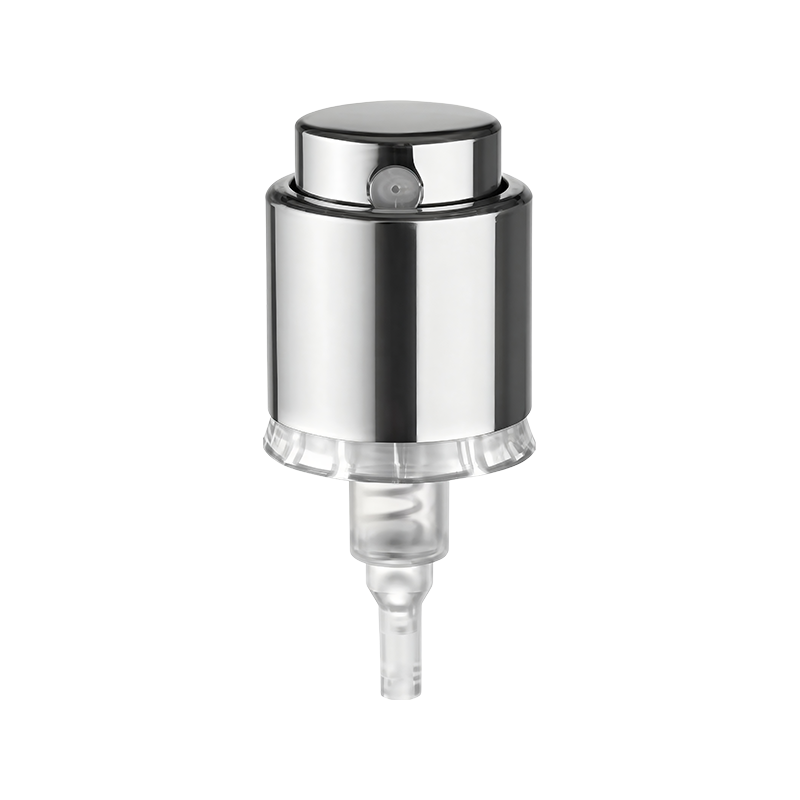
- Metal actuator heads for a luxury weight and feel
- Logo debossing or hot-stamp decoration on the pump head
- Extended nozzle designs that create a distinctive silhouette on-shelf
For B2B buyers sourcing at scale, partnering with a manufacturer that offers both technical compatibility support and customization capability reduces development cycles and ensures the final package reflects the brand's identity without compromising dispensing performance.
What to Evaluate When Sourcing a Treatment Cream Pump
For procurement teams and product developers, selecting the right treatment pump involves a structured evaluation across technical, aesthetic, and commercial dimensions. The following checklist covers the most critical parameters:
- Output volume per stroke — verify it matches recommended application amount for your formula type
- Viscosity range — confirm the pump mechanism is rated for your formula's rheology
- Material compatibility — request a bill of materials and cross-reference against formula ingredients
- Closure fitment — ensure the pump neck finish matches your bottle specification (28/410, 24/410, etc.)
- Actuation force and return speed — evaluate under real-use conditions, including cold temperatures if relevant to target markets
- Evacuation rate — test dip tube length against bottle geometry to minimize residual product
- Customization scope and MOQ — align with brand requirements and production volume realities
Requesting samples for real-world dispensing tests — including drop tests, inversion tests, and extended-use simulations — remains the most reliable way to validate a pump before committing to a production run.
Conclusion: The Pump Is Part of the Product Experience
The treatment cream pump is a functional and experiential component that consumers interact with every single day. Its precision, hygiene benefits, ergonomic feel, and material compatibility directly influence how a skincare formula performs and how a brand is perceived. For manufacturers and B2B buyers, investing in a well-engineered treatment pump is not a packaging upgrade — it is a product quality decision.
Whether you are sourcing for a clinical treatment line, a luxury anti-aging range, or a clean beauty collection, evaluating pump performance with the same rigor applied to the formula itself will result in a finished product that consistently delivers on its promise — from first press to last.
-
How Does Sustainable Packaging Help the Environment? Key Benefits Explained
Spec out a new lotion pump or mist sprayer, and the environmental impact is locked in before the fi...
-
Best Skincare Packaging: How to Choose Bottles, Pumps & Jars That Last
The last time a skincare brand sent us a bottle to test, the cap looked premium but the pump leaked...
-
Airless Bottles Uncovered: How to Protect Your Skincare and Perfect Every Pump
If you have ever opened a pump bottle of serum and found the last quarter of the product impossible ...
-
The Secret to Perfect Skincare Dosing: Choosing the Right Dropper Bottle
The dropper bottle is one of the most familiar formats in skincare — and one of the most underestima...
Copyright © GreenYard Tools Co.,ltd. All Rights Reserved.
Personal Care Packaging Manufacturer Custom Perfume Sprayers Factory